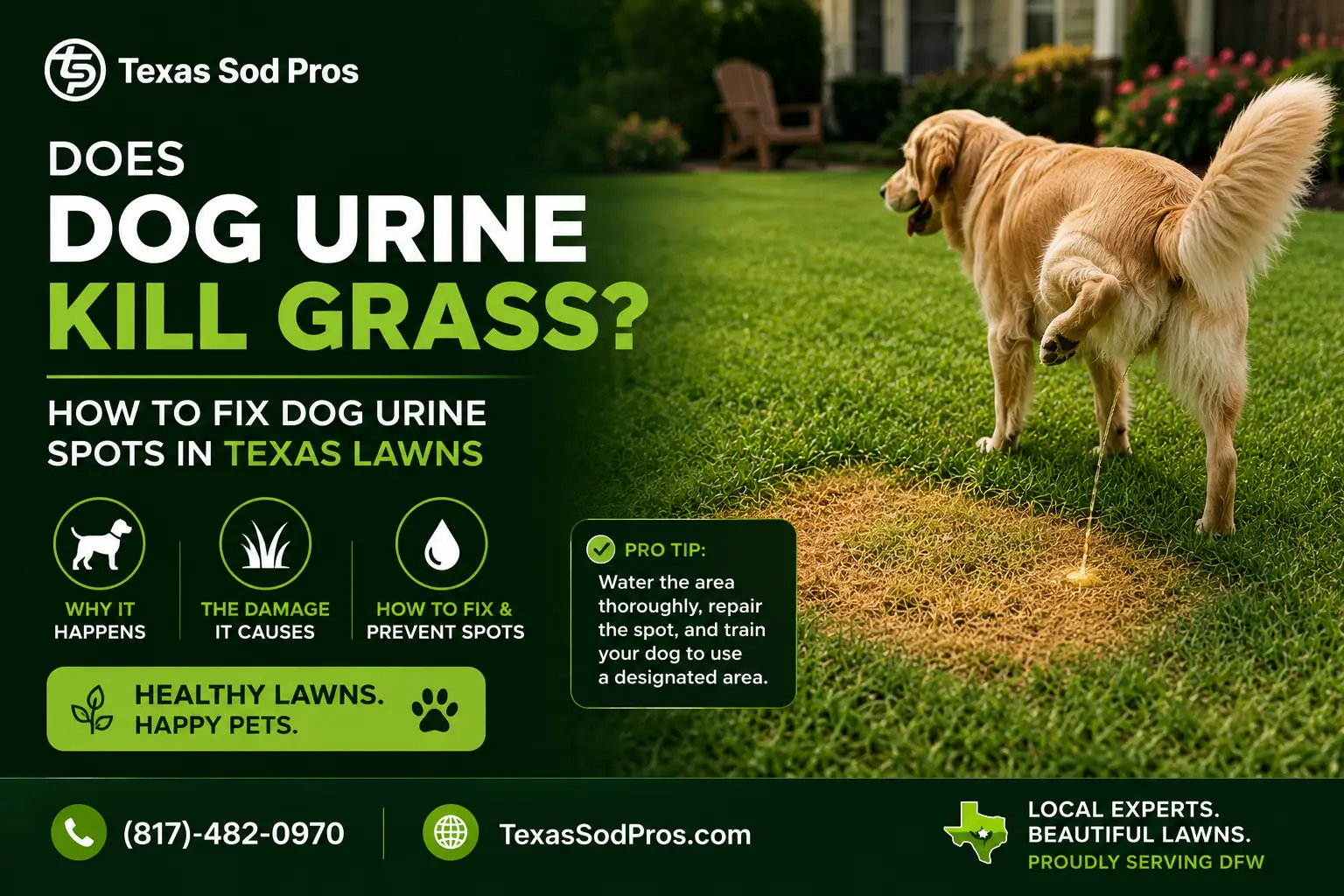
Dogs and healthy lawns can absolutely share the same backyard, but pet traffic can create a few challenges. One of the most common is small yellow or brown circles that seem to appear overnight. That leads many Texas homeowners to ask: does dog urine kill grass?
Yes, concentrated dog urine can damage grass when the same area receives repeated exposure. Some spots recover with proper watering and time, while severely damaged sections may need patch repair or new sod.
The challenge is determining whether dog urine is actually responsible. Texas heat, inconsistent watering, compacted soil, disease, and other lawn problems can create similar discoloration.
At Texas Sod Pros, we help homeowners across Dallas Fort Worth identify damaged turf and determine whether the lawn can recover or needs repair. This guide explains why dog urine spots on grass develop, how to fix them, and how to protect a pet-friendly Texas yard without making lawn care complicated.
Dog urine does not automatically destroy grass every time a pet uses the lawn.
Damage becomes more likely when urine is concentrated in one small area or dogs repeatedly return to the same spot. The grass receives a stronger concentration than it can comfortably handle.
You may notice:
A single mild spot may recover. Repeated exposure in the same place can make recovery much harder.
Understanding why does dog urine kill grass makes the damage easier to manage.
Dog urine contains nitrogen and dissolved salts. Grass needs nitrogen as part of healthy growth, but a concentrated amount deposited in one small area can stress the plant instead of helping it.
Think of it like fertilizer. The correct amount can support growth. Too much concentrated in one location may burn the grass.
Homeowners sometimes notice a brown or yellow center surrounded by unusually green grass.
The center received the strongest concentration. Grass farther from the center received a more diluted amount, which may temporarily encourage greener growth.
This pattern is one clue that you may be dealing with dog urine killing grass rather than uniform drought stress.
Dog urine spots on grass commonly appear as small, concentrated patches instead of widespread lawn discoloration.
They may be:
Location matters. If every damaged spot appears near a favorite bathroom area, pet urine becomes a more likely explanation.
Not every brown patch is caused by a pet.
Before repairing dog pee spots on lawn areas, consider whether the same symptoms could be related to:
If discoloration appears throughout the lawn rather than where your pet spends time, another problem may be involved.
Our guide to yellow grass problems covers other reasons a Texas lawn may lose its healthy color.
Grass turning yellow from dog urine does not necessarily mean it is already dead.
Yellow blades can be an early sign of stress. If the roots and runners remain alive, the turf may begin recovering after the affected area receives appropriate moisture and no additional urine exposure.
Separate the grass blades and look near the soil.
If you still see healthy green growth, runners, or new shoots, give the area time before removing it.
If the turf is completely brown, brittle, bare, and shows no new growth during active growing conditions, repair may be needed.
Will grass grow back after dog urine? In many cases, yes.
Recovery depends on:
Light damage can often recover naturally during active growth. Severe damage may leave a dead center that cannot fill quickly enough on its own.
Warm-season grasses with spreading growth habits may repair small damaged areas better when surrounding turf remains healthy.
Learning how to fix brown spots in grass from dog urine begins with deciding whether the turf is stressed or completely dead.
Avoid immediately covering every spot with fertilizer. Additional nutrients may make a concentrated spot worse rather than better.
If you notice your dog using the same section repeatedly, watering the area can help dilute what remains near the turf and soil surface.
You do not need to flood the yard. The goal is simply to prevent concentrated material from remaining in one small location.
Grass cannot recover easily if the same patch receives new exposure every day.
Temporarily redirect your dog to another part of the yard while damaged turf grows back.
Do not remove yellow grass too quickly.
If the roots and runners remain healthy, normal growth may gradually restore the area.
If the center has died completely, remove loose dead material so the repair area can make good contact with the soil.
Loosen compacted ground and create an even surface before installing replacement grass.
Good soil contact is important when using sod to repair a small section.
For faster cosmetic improvement, small pieces of matching sod can replace dead patches.
Texas Sod Pros provides professional patch repair for homeowners dealing with isolated damaged areas.
Knowing how to repair grass from dog urine is especially useful when the lawn has several completely dead sections.
Sod can provide a cleaner result than waiting for a severely damaged area to fill naturally.
The replacement sod should match the surrounding lawn whenever possible.
Common North Texas sod options include:
If you are not sure what is already growing in the yard, our guide on identifying your grass type can help narrow it down.
Remove the dead turf and shape the repair area so new sod can fit tightly against healthy grass.
Loose dead material underneath replacement sod can reduce soil contact.
Small sod repairs still need establishment care.
Keep the new patch appropriately moist while roots begin connecting with the soil. For more detailed guidance, review our new sod watering schedule.
Different warm-season grasses recover differently, so your repair strategy should consider what is already installed.
Bermuda spreads aggressively during active growing weather and can sometimes fill small damaged spots when surrounding turf is healthy.
If you have Bermuda, learn more about how Bermuda grass spreads.
Larger dead areas may still look better faster with sod patching.
Zoysia creates dense turf but generally fills open areas more gradually than aggressive Bermuda.
Small damage may recover, while larger pet spots can remain noticeable for longer.
You can learn more about how Zoysia grass spreads.
St. Augustine spreads through above-ground runners and can recover from limited damage when healthy surrounding turf remains.
Repeated pet damage, poor watering, or other stress can make those areas harder to fill naturally.
If your St. Augustine lawn is yellow in areas where pets are not active, investigate other causes before assuming urine is responsible.
Prevention is often easier than repairing new spots every month.
You do not need a perfect pet routine, but a few practical changes can reduce repeated lawn damage.
Dogs often develop habits around where they use the bathroom.
A designated section can concentrate wear in a location that is easier to manage rather than scattering patches across an entire front or backyard.
If practical, briefly rinse areas after your dog urinates.
This is especially useful during hot, dry Texas weather when there is little rainfall to naturally dilute the area.
Healthy turf is better positioned to recover from everyday stress.
Support the lawn with:
Choosing the right grass from the beginning matters too. Our comparison of warm-season grass types for Texas lawns can help homeowners evaluate Bermuda, Zoysia, and St. Augustine for different yard conditions.
Homeowners sometimes make a small patch worse by trying to repair it too aggressively.
Because dog urine already introduces concentrated nutrients to a small area, immediately adding more fertilizer is rarely the first step to take.
Diagnose the condition before applying lawn products.
One pet spot does not mean the whole lawn needs additional irrigation.
Watering every zone excessively can create a completely different lawn problem.
Installing new sod in the exact location your dog uses every day may lead to another dead patch.
Change the pet routine or protect the repair area while it establishes.
If spots continue appearing where pets never go, inspect irrigation, drainage, sunlight, soil, and other possible lawn stresses.
A handful of small spots may be manageable as a homeowner project.
Professional help becomes more useful when:
Texas Sod Pros can evaluate whether localized sod patch repair is enough or whether broader lawn replacement makes better sense.
For heavily damaged yards, professional sod installation can provide a consistent new lawn after the causes of the existing damage are addressed.
Texas Sod Pros works with North Texas homeowners who want practical solutions for damaged, patchy, or failing lawns.
Our team helps with sod selection, full installation, lawn replacement, and targeted repairs based on real property conditions.
Homeowners can see examples of completed lawn transformations in our work.
Local customers also share their experiences through the Texas Sod Pros Google Business Profile, giving homeowners a way to review real feedback before choosing a sod company.
If repeated dog urine spots have left your lawn thin or bare, contact Texas Sod Pros to discuss the best repair approach.
Yes, concentrated dog urine can damage grass, especially when a dog repeatedly uses the same small area. Mild spots may recover naturally, while severe damage can require repair.
Dog urine contains concentrated nitrogen and salts. When a large amount reaches a small section of turf, it can stress grass blades and roots.
They commonly appear as small yellow or brown patches and may have greener grass around the outside. The spots often occur in areas where a dog regularly urinates.
Yellowing can be an earlier or milder stage of stress. Grass that remains alive may recover if repeated exposure stops and growing conditions are suitable.
Water the affected area, prevent additional exposure, check whether the turf is still alive, remove completely dead material when necessary, prepare the soil, and patch severe damage with matching sod.
Lightly damaged grass often can. Recovery depends on grass type, severity, root health, season, moisture, and whether the same area continues receiving urine.
Encourage use of a designated area, rinse frequently used sections when practical, maintain healthy turf, and prevent pets from repeatedly using newly repaired patches.
Healthy Bermuda may spread into small damaged areas during active growth. Larger dead patches can still require sod repair for faster coverage.
Do not automatically fertilize them. The damage may already involve concentrated nutrients, so adding fertilizer before identifying the problem can create additional stress.
Replacement is worth considering when the grass is completely dead, bare soil remains, several repairs have failed, or the affected area is too large to recover evenly.
So, does dog urine kill grass? It can, but seeing a few pet spots does not mean the entire lawn needs replacement.
Start by confirming that your dog is actually using the damaged areas. Mild yellow spots may recover when exposure stops, while brown or completely dead sections can be repaired with matching sod.
The best long-term solution combines healthy grass, sensible watering, quick repairs, and a plan that keeps pets from repeatedly stressing the same location.
Texas Sod Pros helps DFW homeowners repair pet-damaged turf and restore lawns with professional patch repair, lawn replacement, and sod installation. If your backyard is becoming more brown than green, contact Texas Sod Pros to discuss your lawn.


