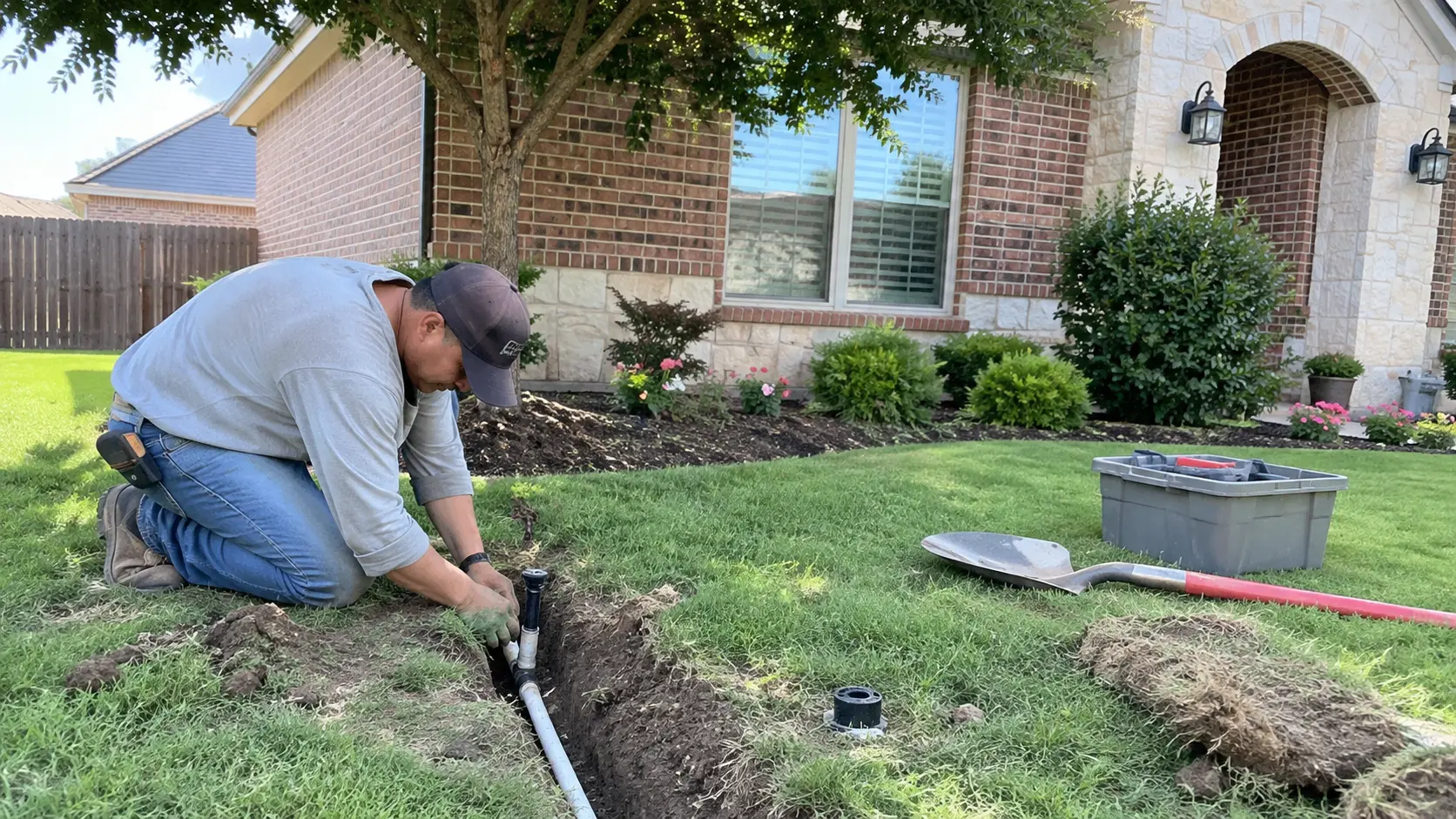
If you are searching for sprinkler system installation cost in DFW, you have probably already noticed that no two quotes look alike. One company says a couple thousand dollars, another says double that, and neither explains why. This guide breaks down what a new irrigation system really costs in Dallas-Fort Worth, what pushes the price up or down, and how to compare bids without getting burned.
The numbers below are general market ranges, not a quote. Only an on site estimate gives you your real price.
Published estimates for Dallas-Fort Worth vary by source, but most residential installs land somewhere between about $2,000 and $5,000. Smaller, simple yards often come in below that range, while large lots with many zones, slopes, or tight access can climb well past it.
A small yard with one or two zones sits at the lower end. An average suburban yard with front and back zones lands in the middle. Large lots with complex landscaping reach the top or beyond. Online prices often mix full installs, partial installs, and repairs, so make sure every bid covers the same scope.
Several factors decide where your quote falls. Knowing them helps you spot a bid that is too good to be true.
A zone is a group of heads run by one valve. More square footage means more zones, pipe, and labor. Lawn, beds, and shaded areas each need their own zones.
Turf usually uses spray or rotor heads, while beds and shrubs do better with drip lines. Most yards use a mix.
North Texas clay is tough to trench, especially when it is dry. Slopes, trees, rock, driveways, and sidewalks add time because pipe has to go around or under them.
A basic timer costs less than a smart controller that adjusts to weather. Smart controllers cost more up front but can cut wasted water.
Texas requires a backflow prevention device, and new systems need rain and freeze sensors. Some cities also require permits. Be wary of any bid that leaves these out.
Texas requires irrigation installs to be done by a licensed irrigator. Always ask for the license number and a written scope.
For many homeowners, yes, especially in DFW where summers are brutal. An automatic system waters early in the morning and in the right amounts, which protects your lawn. Hand watering tends to leave some areas soggy and others dry, and that kind of damage can look like drought. Our post on overwatering grass in Texas explains how to tell the difference.
Irrigation matters most right after a new lawn goes in. Our guide on how to water new sod shows how much water that first month demands.
If you are putting in a new lawn, the smartest move is to plan irrigation first. Trenching through finished sod means cutting it up and repairing it. Installing pipe before the sod goes down is cleaner and often cheaper.
That is why many homeowners bundle the two projects. If you are planning a lawn replacement, the soil is already exposed, which makes it the easiest moment to add or upgrade your system. For a brand new yard, our sod installation team can coordinate timing so the water is ready the day your lawn is laid.
A low bid is not always a good deal. Ask each company the same questions.
You do not have to sacrifice quality to control the price.
If you are searching for a sprinkler installation near me, or want a straight answer on cost, Texas Sod Pros can look at your yard and give you a clear, itemized estimate. We work with homeowners across Dallas-Fort Worth, and we think about the whole lawn, from the soil and the sod to how it gets watered.
No more guessing what a fair price looks like. Request a free estimate, see lawns we have finished on our our work page, or head back to the Texas Sod Pros home page to explore our services.
Most residential systems fall between roughly $2,000 and $5,000, depending on yard size, zones, soil, and equipment. Large or complex yards can cost more. An on site estimate gives you an exact number.
Pricing varies by company and by the work in each zone, so ask for an itemized bid.
Often yes. When the soil is already open, trenching is simpler and there is no sod to cut and repair. Planning both together also keeps your new lawn from going without water.
Many residential systems are installed in one to three days, depending on yard size and access. Larger projects can take longer.
Yes. Texas requires irrigation systems to be installed by a licensed irrigator, so ask any installer for a license number before you sign.
For many DFW homes it is. Smart controllers adjust to weather and can reduce wasted water, which helps both your lawn and your water bill.
Yes, but trenches cut through the turf and need repair. If the lawn is already struggling, replacing it at the same time can be better value. More answers are on our FAQ page.
Ready to plan your lawn and watering the right way? Contact Texas Sod Pros for a free estimate and honest advice.





